
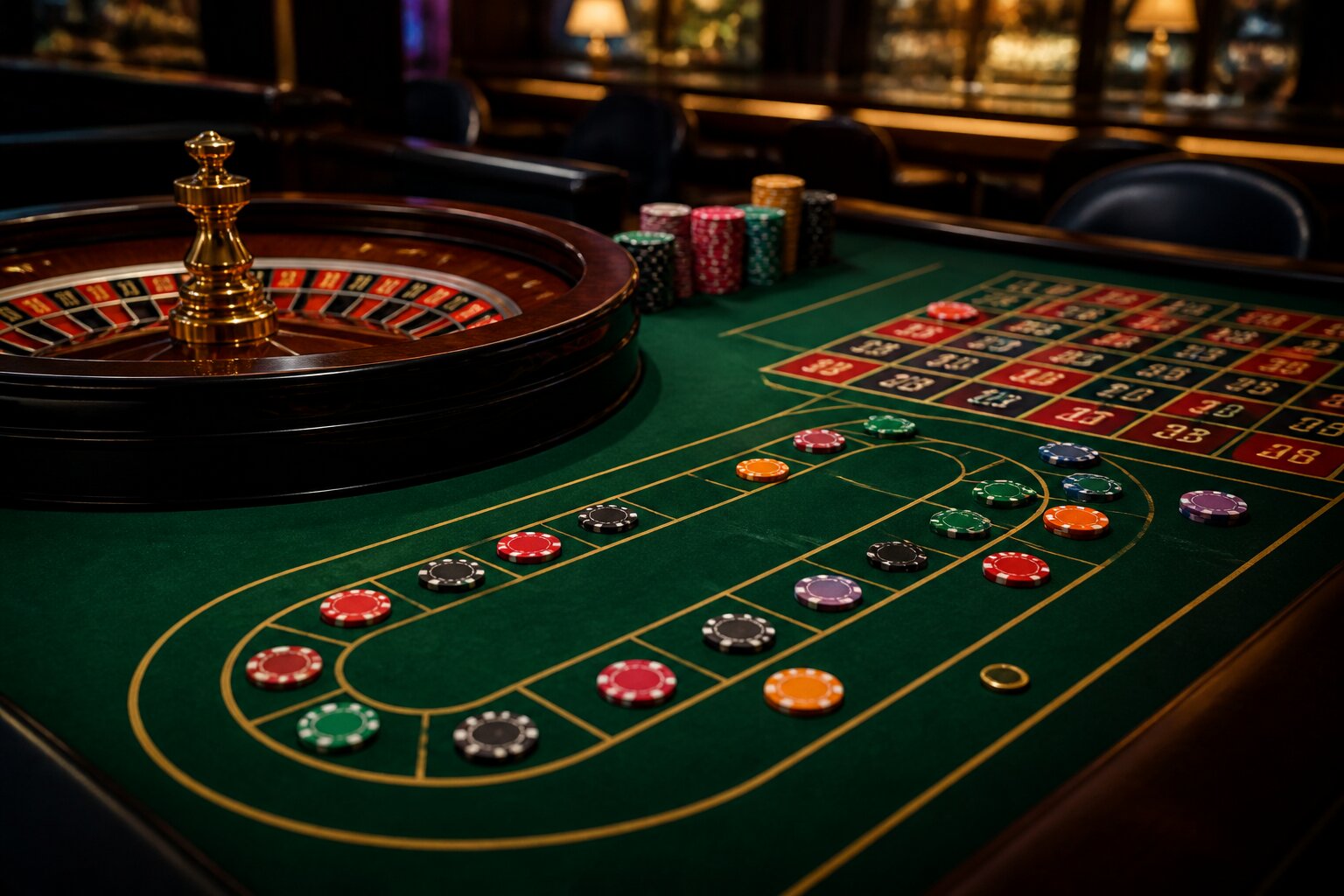
If you’ve ever glanced at the roulette table and wondered what that fancy oval layout is, you’re not alone. The racetrack may look a bit mysterious, but it’s actually a clever shortcut for making special bets that let you cover groups of numbers without placing lots of chips.
Call bets, sometimes called announced bets or French bets, are tied to the racetrack and give you different ways to play beyond the standard grid. This guide explains what the racetrack is for, how call bets work, and how payouts are calculated, whether you’re at a casino or playing online.
Ready to make sense of the racetrack layout and try some new betting options? Let’s dive in.
What Is the Roulette Racetrack?
The roulette racetrack is a dedicated area on many European and French roulette tables that mirrors the physical wheel. Instead of the standard table order, numbers are shown in the sequence they appear around the wheel, arranged in an oval or horseshoe shape.
That layout makes it easy to place bets on numbers that are neighbours on the wheel rather than neighbours on the grid. It’s primarily used for call bets, which let you cover sections such as Voisins du Zéro, Tiers du Cylindre and Orphelins in a single announcement or click.
Because call bets reference the actual wheel order, they help players implement strategies focused on wheel sections without the clutter of multiple individual chips.
Understanding Call Bets in Roulette
Call bets are special wagers that cover specific groups of numbers based on their position on the wheel. Instead of placing chips directly on each number, you either announce the bet to the dealer or select the corresponding area of the racetrack online, and the bet is placed across the relevant numbers.
Each named call bet corresponds to a fixed set of numbers. This makes them useful when you want to cover whole segments quickly, or when you prefer playing combinations that follow the wheel’s layout. They do not alter the underlying odds of the game; they simply provide an alternate, often faster, way to place those bets.
If you plan to use call bets, decide how much you want to stake before you start and stick to that amount. That helps keep the play controlled and clear, especially when several players share the racetrack at a busy table.
A quick note before we look at the layout: the racetrack’s visual order is the key to how these bets are assembled, so the next section shows how the numbers are arranged.
Roulette Racetrack Layout Explained
The racetrack sits beside the main betting grid and shows the numbers 0 to 36 in the same order they appear on the wheel. This makes it easy to see which numbers sit next to one another on the wheel and to place bets that cover those neighbours.
Because the racetrack mirrors the wheel, players can spot large wheel sections at a glance and place bets that reflect wheel sequences rather than table columns or rows. This is especially handy when you want to combine different wager types that all fall within the same wheel segment.
The Main Sections of the Racetrack
Here are the three main sections you’ll see on most racetrack layouts, each defined by contiguous wheel positions.
- Voisins du Zéro (Neighbours of Zero): Covers the numbers closest to zero on the wheel, a larger block that includes 17 numbers.
- Tiers du Cylindre (Third of the Wheel): Covers the 12 numbers roughly opposite zero, forming about one-third of the wheel.
- Orphelins (Orphans): The eight numbers not included in Voisins or Tiers, usually shown as two smaller groups on the racetrack.
These three sections are the common starting points for announced bets, but the racetrack also supports more targeted neighbour bets focused on a single number and its adjacent entries.
How Do You Place Call Bets on the Racetrack?
Placing call bets is straightforward but differs slightly depending on whether you’re at a physical table or online. At a table, you announce the bet to the dealer, for example Voisins du Zéro, and hand over the chips. The dealer will then distribute them across the correct splits, corners and straights that make up that call bet.
Online, you will typically click the racetrack graphic to select the bet, then confirm your stake. The platform will place the appropriate chips automatically across the numbers included in that call.
Timing matters: bets must be declared before the dealer closes betting or the online round moves on. With several players sharing the racetrack, announcing clearly helps avoid confusion about which bets belong to whom.
Now that you know how to place them, the next section describes each common call bet and what numbers it actually covers.
Types of Call Bets & Their Meanings
Call bets each cover a specific group of wheel numbers. Knowing what is included in each named bet helps you choose the mix that best fits your approach. They are placed on the racetrack or announced to the dealer rather than laid out on individual inside chips.
Voisins du Zéro
Voisins du Zéro covers 17 numbers that surround zero on the wheel. The area runs from 22 to 25 across the wheel layout and is typically covered with a combination of splits and corners to match the racetrack positions.
This bet usually requires a larger number of chips than some other calls because of the 17-number span, so players often use a fixed pattern of stakes to cover the full sector. It tends to give a balanced spread of coverage around zero rather than concentrating on single numbers.
Tiers du Cylindre
Tiers du Cylindre covers 12 numbers located opposite zero. The numbers are arranged across a roughly opposite sector of the wheel, meaning this section sits away from zero and balances Voisins when used together.
This section is most commonly covered entirely with split bets. Because it involves 12 numbers, the chip layout is generally neat and repeatable, which makes it a convenient option for staking a consistent portion of the wheel over multiple spins.
Orphelins
Orphelins consists of the eight numbers left over after Voisins and Tiers are defined. These numbers are not contiguous on the wheel, so the bet is usually made with a mix of one straight-up and several splits to link the remaining pockets.
On the racetrack the Orphelins are split into two groups, and players will often cover both groups with the same set of chips to ensure those isolated numbers receive regular coverage. It is a useful choice when you want to cover isolated pockets without committing to the larger spreads of Voisins or Tiers.
Neighbours Bets
Neighbours bets let you pick a single number and cover a set of immediate neighbours around it. The most common format covers five numbers in total: the chosen number plus the two on either side.
You can vary how many neighbours to include depending on the table rules. Typical options include:
- 3-number neighbours: the chosen number and one on each side.
- 5-number neighbours: the chosen number and two on each side.
- 7-number neighbours: the chosen number and three on each side.
These bets are useful when you want to concentrate stakes around a single point on the wheel while still offering some protection for adjacent pockets.
These bet types offer different coverage patterns and chip requirements, so choosing among them depends on whether you want wider coverage or more concentrated stakes on fewer numbers. Consider the number of chips needed, the area of the wheel you wish to influence, and how often you want to repeat the same pattern when selecting a call bet.
Call Bet Rules Every Player Should Know
There are a few practical rules for call bets that keep things running smoothly at the table.
Bets must be declared before the dealer closes betting, and the dealer will place your chips in the precise positions that make up the announced bet. Each call bet requires a specific distribution of chips because it combines straights, splits and corners in set ways.
Some venues may expect chips to be shown up front when a call is declared, a convention that helps avoid disputes. Online, the system handles the distribution but you should confirm your bet amount before the round advances.
These conventions mean you and the dealer are always clear about what has been staked, which makes the round fair and efficient for everyone.
If you’d like to see these rules in practice, observing a live table or a dealer-led online game for a few rounds will make the process feel familiar.
Roulette Racetrack Payouts & Odds
Payouts for call bets follow the same principles as straight and split bets on the main table, because the bets themselves are built from those basic bet types. Outcomes are random and there is no guaranteed result on any given spin, so payouts simply reflect the underlying bet combinations.
- Voisins du Zéro: The bet covers 17 numbers using a mix of splits and corners; payouts depend on whether the winning chip is a split or a corner.
- Tiers du Cylindre: Composed mainly of splits across 12 numbers; winning splits pay according to the standard split rate.
- Orphelins: Combines one straight-up and several splits, so a winning straight pays at the straight-up rate while winning splits pay at the split rate.
- Neighbours Bets: When played as a straight-up plus neighbours, a straight-up win pays at the straight-up rate and split coverage pays at the split rate.
Because call bets are combinations of standard wagers, their effective payout is determined by which specific chip covers the winning number. This is why some bets use more chips and others fewer: the distribution affects the possible payout types when the ball lands on a particular number.
Common Misconceptions About Call Bets
There are a few persistent myths about call bets that are worth clearing up. One is that call bets somehow offer better odds than standard bets; they do not. The mathematical expectations are the same as placing equivalent straight, split or corner bets individually.
Another misconception is that placing bets on a wheel section can influence where the ball lands. Spins are unpredictable and each outcome is independent of previous spins, so no particular section has an intrinsic advantage over time.
Understanding these points helps keep expectations realistic and prevents players from relying on unfounded beliefs about how the wheel behaves.
If you want greater confidence in how call bets work, comparing the chip distribution for a call bet to the equivalent individual chip placements on the main grid will show the correspondence clearly.
Which Roulette Variants Feature the Racetrack?
You’ll most commonly find the racetrack on European and French roulette tables. Both use the single-zero wheel and have the announced-bet conventions the racetrack supports, so the layout fits the way players historically place those bets.
Many live dealer and digital roulette games also include a racetrack graphic. Online versions make it straightforward to place announced bets and mirror the look and feel of a land-based racetrack layout.
Key reasons the racetrack appears on these variants include:
- the single-zero wheel sequence, which matches the racetrack’s ordering of numbers
- the long-established announced-bet traditions in European and French play
- the desire of live and digital providers to offer familiar, user-friendly betting options
American roulette, which uses a different wheel layout, generally does not include a racetrack. The wheel sequence and betting traditions on American tables do not align with the announced-bet format the racetrack supports, so it is rarely provided.
If you prefer to use the racetrack, look for single-zero tables and live dealer or digital versions that explicitly show the racetrack graphic. Checking game descriptions or provider screenshots will usually tell you whether the racetrack is available.
Summary: Why Use the Racetrack & Call Bets?
The racetrack and call bets offer a different way of playing rather than a change in odds. They make it quicker to cover wheel sections and let you play with combinations that reflect the physical wheel order, which some players find more engaging or convenient.
These tools are especially useful when you want to stake particular patterns of numbers without scattering chips across the main grid. Trying them a few times will show how the chip distributions translate into payouts and how the sections feel in play.
**The information provided in this blog is intended for educational purposes and should not be construed as betting advice or a guarantee of success. Always gamble responsibly.