
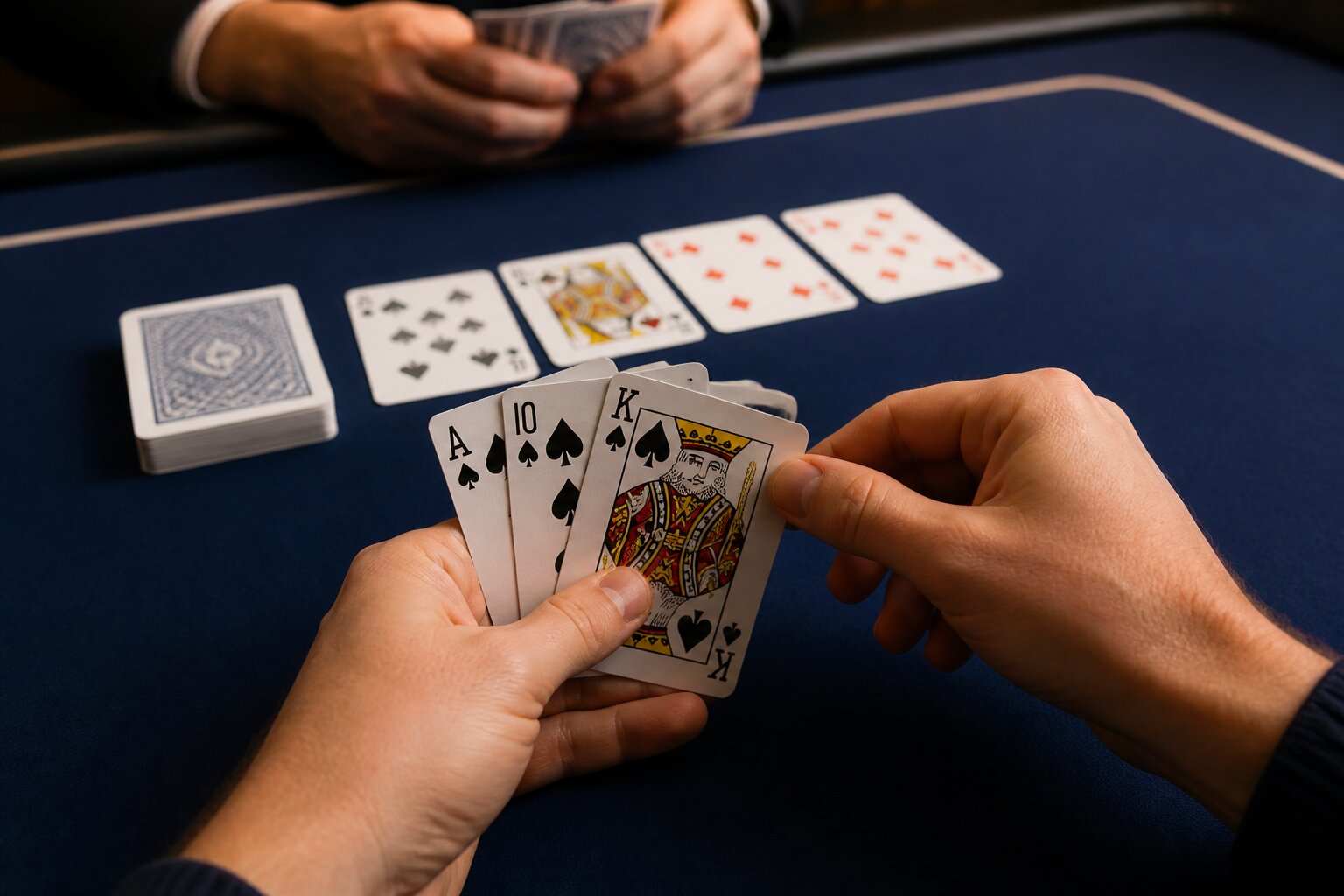
Ever wondered how to play Pontoon and why it’s a firm favourite in British card rooms and online casinos? If you’ve heard of it but never felt confident enough to join a game, you’re not alone.
Pontoon is straightforward to pick up and moves at a brisk pace, so a little knowledge goes a long way. This guide explains the cards, the key decisions you’ll make in a hand, and the terms you’ll hear at the table, all in plain language so you can start playing with confidence.
Ready to master Pontoon? Let’s dive in and build your understanding step by step.
What Is Pontoon & How Does It Differ From Blackjack?
Pontoon shares the basic aim of Blackjack: get a hand value as close to 21 as possible without going over. Where the two games diverge is in detail and tone.
One clear difference is how the dealer’s cards are handled. In Pontoon, both dealer cards are dealt face down, so players don’t see any of the dealer’s cards during play. That changes the psychology at the table and how you approach decisions. Terminology also varies: an Ace with a ten-value card is a “Pontoon” rather than a “Blackjack”, and taking another card is called “twist” while standing is called “stick”.
Rule differences matter too. Players must twist on totals of 14 or less, which commits low hands to a draw, and when a player and dealer both reach 21 the dealer wins. These distinctions affect strategy and the flow of the game, so it’s useful to bear them in mind when you switch between the two games.
Essential Equipment & Card Values in Pontoon
Pontoon uses a standard 52-card deck, with no jokers. In busy home games or casino settings multiple decks may be shuffled together, but each card keeps the same value.
Number cards (2–10) are worth their face value, face cards (Jack, Queen, King) count as 10, and Aces can count as either 1 or 11 depending on which helps the hand. You’ll also need a table, chips or tokens for wagers, and a dealer to handle the pack; online platforms take care of these elements automatically.
Keep your play simple: decide your stake before the round and play only with money you can comfortably afford to lose. That approach keeps the game enjoyable and avoids unnecessary pressure at the table.
How Do You Set Up a Game of Pontoon?
Pontoon works well with a small group or a full table; four to eight players is common. One person acts as dealer and can either rotate each round or remain fixed, according to the players’ preference.
After the deck is thoroughly shuffled, everyone places their bet before any cards are dealt. The dealer then gives two cards to each player, face up, and two cards to themselves, face down. Players can see their own and others’ hands, but not the dealer’s.
Before play begins it’s helpful to agree on any house variations—such as when “buy” is allowed or specific splitting rules—so there’s no confusion mid-round. Clear expectations keep the game moving and fair for everyone.
Step-By-Step Guide to Playing Pontoon
A round of Pontoon unfolds in a predictable pattern, but it’s best understood as a series of choices rather than a strict checklist. After bets are placed and the cards are dealt, each player evaluates their hand and decides how to proceed.
Players take turns choosing to twist (request another card) or stick (keep their current total). If a player’s total is 14 or less, the rules require them to twist; otherwise the choice is optional. At certain points a player may “buy” an extra card by increasing their stake, typically when they hold two to four cards. When the first two cards are of the same value a player can split them into two separate hands and play each hand individually, placing an equal bet on the new hand.
After all players finish, the dealer reveals their cards and plays according to the house rules, usually drawing until a minimum total is reached. Bets are then settled: Pontoons and qualifying Five Card Tricks pay out at higher rates, standard winning hands are paid against the dealer, and ties go to the dealer. If a hand exceeds 21 at any time it is a bust and that stake is lost.
What Are the Key Rules Every Player Must Know?
There are a handful of rules that shape every hand of Pontoon and are useful to keep at the forefront of your mind.
Both of the dealer’s cards remain face down until the players have completed their actions, so you play without seeing the dealer’s total. The strongest possible hand is a Pontoon: an Ace paired with a ten-value card. A Five Card Trick—any five cards totalling 21 or less—beats all non-Pontoon hands. Players with totals of 14 or less must twist; totals of 15 or more may stick. Buying an extra card is permitted in many games by increasing your bet, and splitting identical first two cards creates two separate hands. Finally, when a player’s total equals the dealer’s, the dealer wins the round.
Understanding these rules makes it easier to follow the flow of a round and recognise which options are available in different situations.
When Should You Stick, Twist, Buy or Split?
Decisions in Pontoon centre on four actions: stick, twist, buy or split, and each is best used in certain situations.
Sticking keeps your current total and is only available when the hand is 15 or higher; this is a defensive choice when the risk of busting outweighs the chance of improving the hand. Twisting is the usual way to improve a weaker total, and is mandatory on 14 or less, so those hands will inevitably draw additional cards. Buying an extra card by increasing your stake can be attractive when the current cards suggest a single additional card could form a strong hand, but it raises the amount at risk and is therefore a strategic option rather than a default. Splitting equal first two cards creates two separate hands and can be useful when each new hand has a good chance of competing with the dealer, though it also doubles your exposure for that round.
Recognising the trade-offs in each choice—potential gain versus increased stake or risk of busting—helps you make measured decisions as a hand develops.
How Are Winnings Determined in Pontoon?
Winnings are settled by comparing each player’s final hand with the dealer’s revealed total. A Pontoon is the best result and is paid at an elevated rate; the Five Card Trick is also rewarded more generously than a regular win, but ranks below a Pontoon. Standard winning hands pay according to the house table when the player’s total is closer to 21 than the dealer’s without exceeding it. Any hand that exceeds 21 is a bust and loses immediately. When a player’s total matches the dealer’s total, the dealer wins and the player’s stake is lost.
Payouts and exact rates can vary between venues, so it is sensible to check the table’s rules before playing. Handling your bankroll calmly rather than chasing previous losses keeps the experience under control.
Common Myths About Pontoon Rules Explained
Several misunderstandings circulate about Pontoon and are worth clearing up.
It’s not accurate to say Pontoon is identical to Blackjack; while the core idea is similar, the differences in dealer card handling, mandatory draws on low totals, and tie outcomes create a distinct game. Concealing the dealer’s cards is not a fairness issue—regulated venues and reputable online platforms apply safeguards to ensure cards are dealt and shuffled correctly. The rule that players must twist on 14 or less is sometimes overlooked, so it’s important to know that this is a standard requirement. Finally, options such as splitting or buying offer more choices in play but do not change the underlying probabilities of winning; they are tools for managing individual hands rather than guaranteed advantages.
If anything in a particular game looks unclear, asking the dealer or checking the house rules is the quickest way to resolve it.
Where Can You Play Pontoon in the UK?
Pontoon is commonly offered at many land-based casinos and is also available through a number of online casino games. In person, dedicated tables in larger venues often host Pontoon sessions, while smaller clubs or casinos may run mixed table games or single-deck variants at quieter times. Online, the game appears alongside other table games and is usually managed by the platform’s software, either as a random number generator version or as a live dealer game streamed from a studio.
Choosing a reputable operator matters more than a flashy brand. Look for evidence that the site or venue is licensed and regulated, and that it supports safe play. In particular, check for the following:
- clear rules so you understand how hands are judged and side bets, if any, work
- transparent payout information so you know what to expect for wins and returns
- accessible player support and responsible gambling tools, such as deposit limits and self-exclusion options
Those factors give you a clearer idea of how the game will run and what tools are available if you need assistance.
Pontoon FAQs
Here are concise answers to common questions about Pontoon.
What is the minimum age to play Pontoon in the UK?
You must be at least 18 years old to play Pontoon for money in the UK.
How many players can play Pontoon at once?
Pontoon can be played by two or more players; most tables accommodate up to eight players.
What happens if both the dealer and the player have 21?
If both the player and the dealer have 21, the dealer wins that round.
Can I play Pontoon online in the UK?
Yes, Pontoon is available online. Check the site’s information to confirm how the game is run and what player protections are in place.
What do I do if I think I’m playing too much?
If you have concerns about your gambling, take a break and seek support through available help channels or the tools provided by the venue you’re using.
This guide has covered the rules, common choices and typical situations you’ll encounter in Pontoon. With these points in mind you can approach the game with a clearer sense of how hands play out and what decisions matter most.
**The information provided in this blog is intended for educational purposes and should not be construed as betting advice or a guarantee of success. Always gamble responsibly.