
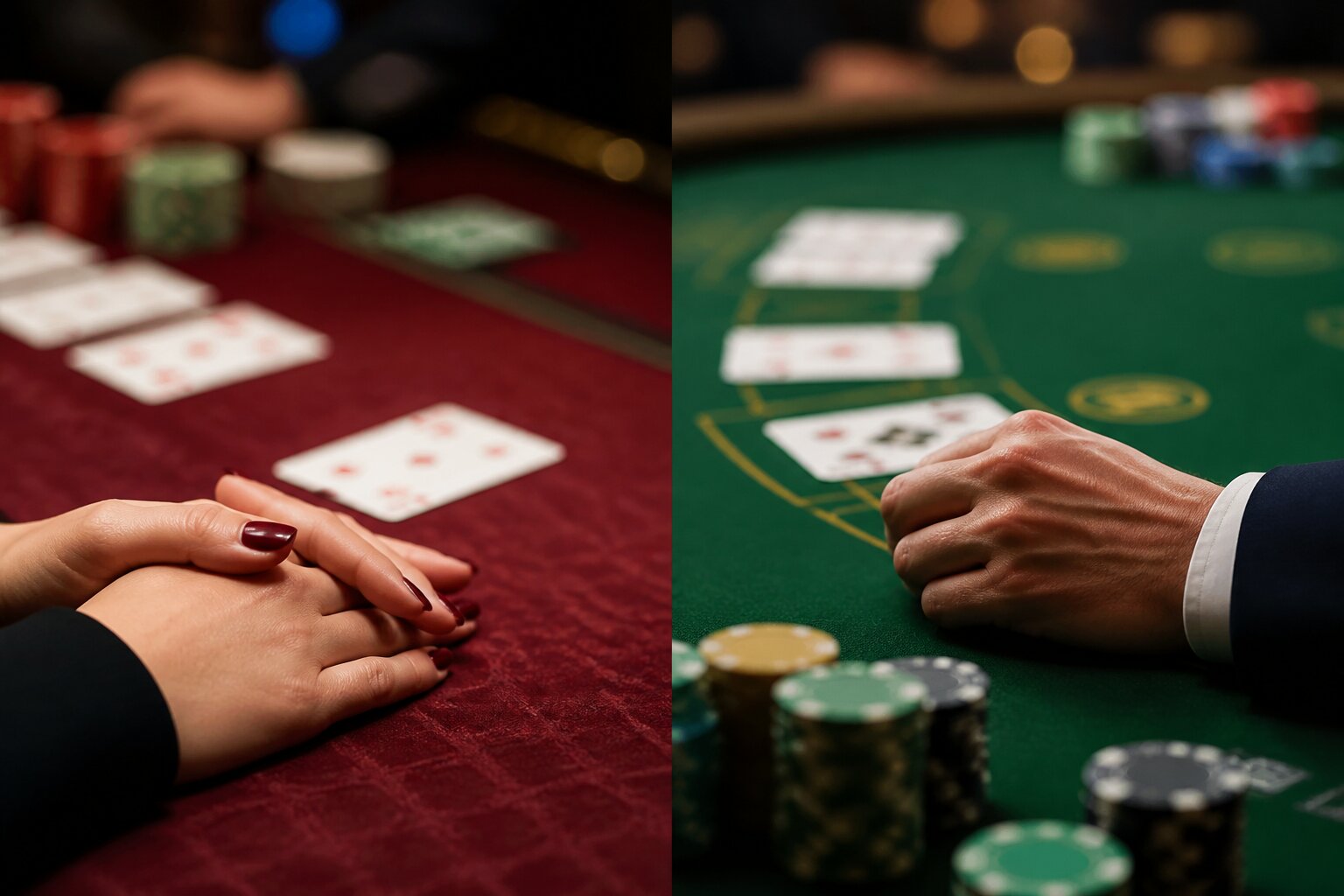
Are you torn between playing baccarat or blackjack at your favourite online casino? You’re not alone. Both games are widely played and offer very different experiences: baccarat with its quiet, measured rhythm, and blackjack with its choice-driven rounds.
Which game suits you depends on whether you enjoy making decisions every hand or prefer to watch the outcome unfold after you place a bet. Read on and you’ll get a clear, practical comparison of rules, gameplay and what to expect at the table.
What Are The Main Differences Between Baccarat And Blackjack?
At first glance both games use cards and aim for a strong hand, but their player roles and pacing set them apart.
Blackjack is interactive: you receive cards and then decide whether to take more, stand, or use options such as doubling or splitting where allowed. The central objective is to attain a total as close to 21 as possible without exceeding it, and the choices you make shape each round.
Baccarat is largely driven by fixed dealing rules rather than player decisions. Players place a bet on one of three possible outcomes—the player hand, the banker hand, or a tie—and the dealer follows preset rules to determine any additional cards. The winning hand is the one closest to a total of 9, with card values defined differently from blackjack.
These structural contrasts also affect table tempo: baccarat rounds tend to be quicker, while blackjack can slow down if players take time over decisions. With that comparison in mind, let’s look at the rules that govern each game.
How Do The Rules Of Baccarat And Blackjack Compare?
Both games are rule-driven, but the specifics differ enough that you’ll learn distinct skills for each.
In blackjack, the values are straightforward: numeric cards count at face value, face cards count as 10, and aces can be 1 or 11 depending on what benefits the hand. Play involves responding to your initial two-card hand by deciding whether to take more cards or stand. The dealer follows a defined policy for their own play, and ties or specific blackjack outcomes have their own payout conventions.
Baccarat uses a different value system: cards 2–9 are worth their face value, tens and face cards count as zero, and aces count as one. Totals are taken only from the last digit—so a 13 is treated as a 3. After the initial two cards, a third card may be drawn, but that decision follows a fixed set of table rules rather than player choice. Bets on player, banker and tie have distinct payout structures and, in some cases, commission on banker wins.
Understanding these rule differences will help you decide which table rhythm and decision load you prefer. Next, we’ll consider how easy each game is to learn.
Which Game Is Easier To Learn?
Both games are accessible, but they appeal to different learning styles.
Baccarat’s appeal for beginners lies in its simplicity: there are fewer rules to memorise and no in-round decisions to make once bets are placed. Players observe the dealing rules and outcomes, which makes it quick to pick up and soothingly predictable in structure.
Blackjack requires more initial study because the choices you make affect the result. Learning when to hit, stand, double or split—and how aces behave—takes practice. That effort is rewarded by a more engaged experience and the possibility to influence short-term results through better decision-making.
So, ease depends on whether you prefer a hands-off game you can follow instantly, or a skill-influenced game where learning improves how you play. Now let’s walk through a typical round of baccarat so the mechanics are clear.
Gameplay Explained: Baccarat
A standard baccarat round begins with bets placed on player, banker or tie, then the dealer deals two cards to each hand.
Card values work differently than in blackjack: 2–9 count at face value, tens and face cards are zero, and aces are one. Totals are reduced to their last digit, so a hand of 7 + 6 becomes 3. After the initial deal, the table’s dealing rules determine whether a third card is drawn for either hand; players do not decide this. The hand nearest to 9 wins, and payouts reflect which bet you made.
This structure makes baccarat straightforward to follow at the table, and it suits players who prefer observing the action rather than steering it. With that clear picture of baccarat, let’s switch to the more decision-led flow of blackjack.
Gameplay Explained: Blackjack
Blackjack mixes simple card values with choices that shape each hand’s outcome. Players start by placing a bet, then receive two cards, hoping their total compares favourably to the dealer’s without exceeding 21.
Cards 2–10 count at face value, face cards as 10, and aces as 1 or 11 depending on which helps the hand. Players see both their cards, while the dealer typically shows one card and keeps the other face down. The player then chooses whether to take another card or stand; in many games there are also options to double the bet for one additional card or split a pair into two hands when appropriate. After players finish, the dealer reveals their card and follows fixed rules to play out their hand.
Blackjack’s appeal is the influence players have on outcomes through informed choices, making strategy and familiarity worthwhile. Now that you’ve seen how each game plays, here’s how winners are determined.
How Are Winners Decided In Each Game?
Each game relies on a clear numerical comparison, but the winning criteria differ.
In baccarat, the hand with the total closest to 9 wins. Totals are calculated using baccarat’s value system and only the final digit matters. Bets that correctly predict the winning hand are settled according to the table’s payout rules.
In blackjack, a player’s hand wins if it is higher than the dealer’s without exceeding 21. If a player busts—goes over 21—they lose that hand regardless of the dealer’s result; if both dealer and player have the same total, the result is typically a push (tie), and the player’s stake is returned.
Both games use fixed rules for settling bets and resolving ties, so knowing those specifics before you sit down helps you understand outcomes more clearly. Let’s turn to how the casino’s advantage compares between the two.
House Edge: Which Game Fares Better?
House edge describes the long-term statistical advantage the casino holds, and small differences here can affect expected results over many plays.
In baccarat, betting on the banker usually gives the lowest house edge, betting on the player is slightly less favourable, and tie bets carry the highest edge. Some casinos apply a commission to banker wins, which influences the effective edge.
Blackjack’s house edge depends significantly on rule variations: number of decks, whether the dealer hits or stands on a soft 17, doubling and splitting rules, and payout for blackjack. Player decisions also change the effective edge—using optimal strategy reduces it, while poor choices raise it.
Understanding these nuances helps you choose the game and table rules that suit your preferences and playing style. Next, we’ll debunk a few common misconceptions about these games.
Common Myths About Baccarat And Blackjack
Several persistent myths can lead players to false expectations; knowing the facts keeps play sensible and informed.
One myth is that patterns in past results reliably predict future outcomes. Both games operate with random dealing mechanisms, so each round is independent. Another misconception is that a lower house edge guarantees frequent short-term wins; house edge only reflects long-run averages. Finally, the idea that observing dealers or other players yields a winning method is misleading—no observation alters the underlying probabilities.
Keeping these clarifications in mind makes it easier to approach either game with accurate expectations. If you’re curious which game UK players tend to choose, read on.
Which Game Is More Popular In The UK?
Both games have solid followings in the UK, but blackjack is generally more familiar and widely played.
Blackjack’s presence in films, television and mainstream culture has helped its popularity, and it’s commonly available across venues in multiple formats and stake levels. Baccarat finds a dedicated audience too, often among players who like its simplicity and steady rhythm, though it tends to appear less frequently than blackjack in some venues.
Either choice is a matter of personal taste and how involved you want to be during play. If you’re weighing up which to try, the next section offers a practical way to choose.
How To Choose Between Baccarat And Blackjack
Choosing comes down to what you enjoy at the table and how much influence you want over each round.
If you relish making on-the-spot choices and learning how those choices affect outcomes, blackjack rewards that involvement and study. If you prefer a simpler betting decision with a consistent pace and fewer in-round choices, baccarat may suit you better. Consider also the table limits and rule variations on offer, as these affect both the experience and the game’s statistical characteristics.
Whatever you pick, treat gaming as entertainment and set spending limits you’re comfortable with so the activity stays controlled and enjoyable.
**The information provided in this blog is intended for educational purposes and should not be construed as betting advice or a guarantee of success. Always gamble responsibly.